
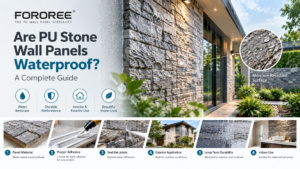
Are PU stone wall panels waterproof? This is one of the most common questions homeowners, contractors, architects, importers, and distributors ask before choosing decorative wall materials.
PU stone wall panels can offer good resistance to moisture, but their actual waterproof performance depends on the specific product, panel construction, installation method, joints, and surrounding wall system.
Unlike natural stone or traditional masonry, PU stone panels are lightweight decorative panels designed to reproduce the appearance of stone, brick, rock, and other architectural surfaces. Their moisture resistance makes them attractive for many interior and exterior decoration projects, but not every PU panel is suitable for every wet environment.
In this guide, we explain how water-resistant PU stone panels are, whether they can be used outdoors, how to protect joints from water infiltration, and what buyers should check before purchasing.
1. Are PU Stone Wall Panels Waterproof?
PU stone wall panels are generally made primarily from polyurethane, a material that can provide good resistance to water absorption under appropriate conditions.
However, it is important to distinguish between water-resistant panel material and a waterproof wall system.
A panel may resist occasional splashes or rain exposure, while water can still enter the wall through:
- Open or poorly sealed joints
- Unprotected cut edges
- Gaps around windows and doors
- Screw or fixing penetrations
- Unsealed top and bottom edges
- Cracks in the underlying wall
- Incorrectly designed drainage details
For this reason, the waterproof performance of an installed wall depends on more than the panel itself.
Before selecting a product, check the manufacturer’s technical specifications and confirm whether the panel is approved for the intended environment.
Quick Answer
| Question | Answer |
|---|---|
| Are PU stone panels water-resistant? | Many products offer good moisture resistance, but performance is product-dependent. |
| Are all PU stone panels waterproof? | No. Do not assume every product has the same waterproof performance. |
| Can they be used on exterior walls? | Some are designed for exterior use. Confirm the product specifications. |
| Can they be installed in bathrooms? | Some applications may be suitable, but wet-area approval is essential. |
| Can they be used inside a shower? | Only when the complete system is specifically approved for direct, continuous water exposure. |
| Do joints need sealing outdoors? | Often, depending on the product and installation system. |
2. Why Can PU Stone Panels Resist Moisture?
PU stone panels have several characteristics that can make them suitable for decorative applications where moisture resistance is important.
Low Water Absorption Potential
Polyurethane is not a porous natural stone in the conventional sense. Many PU decorative panels have a surface that resists water absorption, helping them withstand ordinary moisture exposure.
Actual performance depends on the formulation, surface coating, panel structure, and manufacturing quality.
Lightweight Construction
PU stone panels are considerably lighter than many natural stone products. This can simplify handling, transportation, and installation.
However, lightweight construction does not automatically mean a panel is waterproof or suitable for exterior use. Those properties must be confirmed separately.
Decorative Surface Protection
Many PU panels have a finished surface designed to reproduce the texture and color of natural stone.
The surface finish may contribute to moisture resistance, but scratches, damaged coatings, exposed edges, and installation defects can affect performance.
Easier Maintenance in Suitable Applications
Where the manufacturer approves the application, PU panels can often be cleaned with suitable non-abrasive methods.
Avoid aggressive chemicals, abrasive tools, or pressure washing unless the product manufacturer confirms that these cleaning methods are safe.
3. Can PU Stone Wall Panels Be Used Outdoors?
Yes, PU stone wall panels specifically designed and approved for exterior applications can be used in outdoor decorative projects.
Potential applications include:
- Villa exterior walls
- House façades
- Garden feature walls
- Courtyard walls
- Boundary and fence walls
- Entrance walls
- Outdoor restaurant decoration
- Commercial exterior features
- Selected landscape and hospitality projects
However, exterior use requires more than moisture resistance.
Outdoor panels may face rain, wind, sunlight, temperature changes, humidity, and, in some regions, freeze-thaw conditions.
Before installing PU stone panels outdoors, confirm the following.
1. Exterior Suitability
Ask the manufacturer whether the exact model is intended for exterior use.
An interior decorative panel should not automatically be used on an exterior wall.
2. UV and Weathering Performance
Sunlight can affect certain coatings, pigments, and surface finishes over time.
Ask for available UV, weathering, or exterior exposure test information where relevant.
3. Adhesive Compatibility
The adhesive must be compatible with the panel and substrate and suitable for the local outdoor conditions.
An interior construction adhesive may not be appropriate for an exterior installation.
4. Mechanical Fixing
Depending on the product, building height, substrate, wind exposure, and local requirements, additional mechanical fixing may be necessary.
Follow the manufacturer’s instructions and applicable building requirements.
5. Joints and Edge Protection
Water may enter through joints, corners, penetrations, and exposed edges if these details are not properly designed.
Exterior installations should follow the manufacturer’s recommendations for joint treatment, sealants, drainage, and weatherproofing.
4. Can PU Stone Panels Be Used in Bathrooms?
Bathroom use requires careful consideration because different areas experience very different levels of moisture.
Bathroom Feature Walls
In a bathroom with normal ventilation, some PU decorative panels may be suitable for a feature wall if the manufacturer approves the application.
Keep the panels away from direct water exposure unless the product is specifically approved for it.
Areas Near a Washbasin
A panel near a washbasin may experience splashes, cleaning products, and occasional moisture.
Confirm the panel’s cleaning and moisture-resistance requirements. Seal transitions where required by the approved installation system.
Shower Walls
Direct shower exposure is much more demanding.
Do not assume that a water-resistant PU panel is a substitute for a waterproof shower-wall system.
Before using PU panels in a shower, confirm that the entire assembly—including the panel, joints, corners, penetrations, substrate, and waterproofing layer—is approved for continuous direct water exposure.
Where no such approval exists, choose a wall system specifically designed and tested for shower applications.
5. Can PU Stone Panels Be Used in Kitchens?
PU stone panels may be suitable for selected kitchen decorative applications, depending on the product and its installation requirements.
Potential locations include:
- Kitchen feature walls
- Dining-area accent walls
- Decorative walls away from the sink
- Certain backsplash applications, if specifically approved
Before using PU panels near sinks or cooking areas, check their resistance to water, heat, grease, and cleaning products.
Do not install a panel close to a stove, open flame, or another heat source unless the manufacturer confirms that the product is suitable for the expected temperatures and local safety requirements.
For areas subject to frequent splashing or intensive cleaning, a product specifically designed for that environment may be a better choice.
6. What Happens If Water Gets Behind PU Stone Panels?
Water behind a decorative wall panel can create problems even when the panel face itself resists water.
Potential consequences include:
- Damage to the underlying wall
- Reduced adhesive performance
- Moisture trapped behind the panel
- Mold or mildew on susceptible materials
- Deterioration of surrounding finishes
- Corrosion of unsuitable fixings
The actual risk depends on the substrate, moisture source, ventilation, drainage, and installation system.
Important Principle
A moisture-resistant decorative panel should not be treated as a replacement for repairing leaks or designing a proper waterproofing system.
If the original wall has water infiltration, condensation, or rising damp, solve the underlying problem before installing the panels.
For exterior walls, the building envelope must be designed to manage water appropriately. Decorative cladding alone may not provide all the required weather protection.
7. How to Improve Moisture Protection During Installation
Correct installation is essential for achieving reliable performance.
Step 1: Inspect the Substrate
The wall should be stable and properly prepared.
Repair cracks, remove loose material, and address active leaks before installation.
Step 2: Choose the Correct Adhesive
Use an adhesive approved for the specific PU panel and substrate.
For exterior applications, confirm that it can withstand the expected environmental conditions.
Step 3: Follow the Recommended Joint Details
Not every PU panel uses the same joint design.
Follow the manufacturer’s instructions for joint spacing, sealant, filler, and overlapping details.
Step 4: Protect Cut Edges
Cut edges may expose areas that were not part of the original finished surface.
Use compatible touch-up coatings, sealants, or edge treatments where specified.
Step 5: Seal Transitions Where Required
Pay particular attention to:
- Window and door frames
- Outside corners
- Wall penetrations
- Top edges
- Bottom edges
- Connections to other materials
Choose sealants compatible with the panel and adjacent materials.
Step 6: Follow Exterior Fixing Requirements
Where mechanical fixings are specified, use the approved fasteners and installation details.
Do not rely on adhesive alone when the product or project requirements call for additional fixing.
Step 7: Inspect the Finished Wall
After installation, check for open joints, gaps, damaged surfaces, and incomplete edge sealing.
Correct defects before the wall is exposed to moisture.
8. How to Check the Waterproof Performance of PU Stone Panels
For importers, distributors, contractors, and project buyers, product photos are not enough to confirm waterproof performance.
Ask the supplier for clear technical information.
Request Product Specifications
Check:
- Panel material and construction
- Intended interior or exterior application
- Installation method
- Recommended adhesive
- Joint treatment requirements
- Cleaning and maintenance instructions
Ask for Relevant Test Reports
Where water resistance or weatherproof performance is important, ask whether the manufacturer has applicable test reports.
Depending on the intended application, relevant evidence may include water absorption measurements, water exposure tests, or exterior weathering assessments.
A test report should identify the tested product and method. A result for one model does not automatically prove that every product in the range has identical performance.
Test the Complete Assembly
For a major project, consider evaluating a representative installation sample rather than testing the decorative panel alone.
The sample should include the actual substrate, adhesive, joint details, corners, and penetrations expected in the project.
This gives a more useful indication of how the assembled system will perform.
9. PU Stone Panels vs. Natural Stone: Which Handles Water Better?
Neither material should be judged by appearance alone. Their performance depends on material properties, surface treatment, installation, and the overall wall construction.
| Factor | PU Stone Panels | Natural Stone |
|---|---|---|
| Material | Manufactured polyurethane decorative panel | Natural quarried stone |
| Weight | Generally lightweight | Varies; often much heavier |
| Water absorption | Product-dependent; many surfaces resist moisture | Varies by stone type, porosity, and treatment |
| Joint protection | Depends on panel design and installation system | Depends on stone layout, grout, and wall system |
| Exterior use | Only models approved for exterior use | Depends on stone type and installation design |
| Maintenance | Product-specific cleaning instructions | Depends on stone type and surface finish |
| Installation | Often easier to handle and cut | May require heavier support and specialist installation |
| Waterproof wall performance | Depends on the complete system | Depends on the complete system |
Natural stone is not automatically waterproof, and PU panels are not automatically suitable for every wet environment. The right choice depends on the project requirements.
10. Common Myths About PU Stone Panel Waterproofing
Myth 1: All PU Stone Panels Are 100% Waterproof
Reality: Products differ in construction and intended use. Confirm performance for the exact model.
Myth 2: A Waterproof Panel Makes the Whole Wall Waterproof
Reality: Joints, penetrations, edges, substrate conditions, and drainage details all matter.
Myth 3: Every PU Stone Panel Can Be Used Outdoors
Reality: Exterior suitability must be verified with the manufacturer.
Myth 4: PU Panels Can Always Be Installed in Showers
Reality: Direct, continuous water exposure requires approval for the complete wall system.
Myth 5: Water Resistance Means Heat Resistance
Reality: Moisture performance and heat resistance are different properties. Check both when selecting panels for kitchens, fireplaces, or other high-temperature areas.
11. What Should Importers and Distributors Ask Their Supplier?
If you plan to sell PU stone wall panels in your market, moisture resistance can be an important product-selection and customer-service topic.
Before placing a bulk order, ask the manufacturer:
- Which models are designed for exterior applications?
- Are there any water-resistance or weathering test reports?
- What adhesive is recommended?
- What are the required joint and edge details?
- Are any wet areas excluded from the recommended applications?
- What cleaning products should end users avoid?
- Are installation guides and technical documents available?
- Can the factory provide samples for evaluation?
Clear answers help reduce misunderstandings between suppliers, distributors, installers, and end users.
They also help distributors explain product limitations responsibly instead of making broad claims that may not apply to every model.
12. Frequently Asked Questions
Are PU stone wall panels waterproof?
Many PU stone panels offer good resistance to moisture, but their actual performance depends on the material construction, surface finish, and installation system. Check the technical specifications of the exact product.
Can rain damage PU stone wall panels?
Exterior-rated PU stone panels are designed for their specified outdoor conditions. However, inappropriate installation, damaged coatings, unsealed joints, or unsuitable products can cause problems over time.
Do PU stone panels need waterproofing behind them?
That depends on the substrate, application, and complete wall system. Areas with direct water exposure or specific building-envelope requirements may need a separate approved waterproofing layer.
Can PU stone panels be installed over a damp wall?
Active moisture problems should be resolved first. A damp, unstable, or leaking substrate may compromise the adhesive and damage the wall assembly.
Can PU stone panels be washed with water?
Cleaning methods depend on the product. Use the manufacturer’s recommended cleaning procedure and avoid high-pressure washing or aggressive chemicals unless specifically approved.
Are PU stone panels suitable for exterior villa walls?
Some PU stone panels are designed for villa façades and other exterior decorative applications. Confirm weather resistance, fixing requirements, and local building requirements before installation.
Do PU stone panels prevent mold?
A panel should not be considered a mold-prevention solution. Mold can develop on susceptible materials when moisture and suitable conditions are present behind or around the panels. Proper moisture control and ventilation are important.
How can I verify the waterproof performance before importing?
Ask for model-specific technical documentation and relevant test reports. For important projects, evaluate a sample installation using the intended substrate, adhesive, joint treatment, and fixing method.
Conclusion: Are PU Stone Wall Panels Waterproof?
PU stone wall panels can be a practical choice for decorative applications where moisture resistance, lightweight construction, and realistic stone textures are important.
However, water resistance is not the same as guaranteeing a fully waterproof wall.
The right product must match the intended application, and the complete installation must account for the substrate, adhesive, joints, edges, fixings, and water management.
For interior feature walls, moisture-resistant PU panels can offer a convenient decorative solution. For exterior walls, bathrooms, or other demanding environments, confirm the exact product’s suitability and follow the manufacturer’s approved installation system.
Explore PU Stone Wall Panels from FOROREE
FOROREE specializes in PU wall panels and PU stone wall panels for residential, commercial, and architectural decoration markets.
Our product direction covers traditional stone-inspired textures as well as modern decorative PU wall panels. For distributors, contractors, and project buyers, selecting the correct model for the intended application is an important part of the purchasing process.
When evaluating products, buyers should confirm:
- Intended interior or exterior use
- Product dimensions and construction
- Installation recommendations
- Available technical documentation
- Packaging and wholesale requirements
- OEM/ODM options
Looking for PU Stone Panels for Your Next Project?
Contact FOROREE to request product information, samples, and installation recommendations for your intended application.
FOROREE — The PU Wall Panel Specialist
Realistic Stone. Modern Design. Lightweight Installation.