
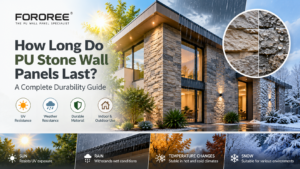
How long do PU stone wall panels last? This is an important question for homeowners, contractors, architects, importers, and distributors considering PU stone panels for residential or commercial projects.
PU stone wall panels are lightweight decorative materials designed to replicate the appearance of natural stone, brick, rock, and other architectural surfaces. They are relatively easy to handle and install, making them an attractive alternative to heavier decorative wall materials.
High-quality PU stone wall panels can provide many years of service when properly selected, installed, and maintained. However, their actual lifespan depends on product quality, surface coating, installation method, environmental exposure, and maintenance.
Some manufacturers advertise expected service lives of approximately 15–25 years under specified conditions. This should be treated as a product-specific planning reference, not a universal industry guarantee. Outdoor panels may experience surface fading or coating deterioration before the panel itself needs replacement.
In this guide, we explain what affects the lifespan of PU stone wall panels, how indoor and outdoor conditions differ, and how buyers can choose more durable products.
1. How Long Do PU Stone Wall Panels Usually Last?
There is no single lifespan that applies to every PU stone wall panel.
Different manufacturers use different polyurethane formulations, molding processes, surface coatings, installation systems, and quality-control procedures. As a result, the service life of one product may differ considerably from another.
For preliminary planning, some manufacturers advertise a service life in the range of 15–25 years under suitable conditions. Before using any specific figure for a project, ask the manufacturer to explain the conditions behind the claim and whether it is supported by product testing or warranty documentation.
It is also important to distinguish between two types of durability.
Structural and Material Durability
This refers to how well the panel retains its physical integrity over time.
Relevant concerns include:
- Cracking
- Warping
- Delamination or separation of layers
- Damage around fixings
- Deterioration caused by unsuitable installation conditions
Appearance and Surface Durability
This refers to how well the panel retains its original decorative appearance.
Relevant concerns include:
- Color fading
- Chalking
- Peeling or deterioration of coatings
- Scratches
- Surface discoloration
- Dirt accumulation
A panel may remain physically intact even after its color or finish has begun to change. For this reason, the service life of the material and the period during which it maintains its original appearance are not necessarily the same.
2. How Long Do PU Stone Panels Last Indoors?
Indoor applications generally expose PU stone panels to fewer environmental stresses than outdoor applications.
Interior panels are usually protected from direct rainfall, intense sunlight, strong wind, and large outdoor temperature fluctuations.
When the product is suitable for indoor use and properly installed, potential applications include:
- Living room feature walls
- TV background walls
- Bedroom decoration
- Hotel interiors
- Restaurant walls
- Retail stores
- Office reception areas
- Exhibition and display spaces
- Commercial interior decoration
For these applications, the main durability considerations are product quality, installation stability, physical impact, cleaning practices, and exposure to heat or chemicals.
Factors that help extend indoor service life
Choose a suitable panel. Select products intended for the application rather than choosing based on appearance alone.
Prepare the wall correctly. A clean, stable substrate helps prevent bonding problems.
Use compatible adhesives. The adhesive should be approved for the specific panel and substrate.
Avoid excessive heat. PU decorative panels should not be installed near open flames or high-temperature sources unless the exact product has been approved for that application.
Clean the surface correctly. Use the manufacturer’s recommended cleaning methods to avoid damaging decorative coatings.
For most indoor projects, correct installation and protection from physical damage are particularly important.
3. How Long Do PU Stone Panels Last Outdoors?
Outdoor durability requires more careful evaluation.
Exterior PU stone panels may be exposed to direct sunlight, rainfall, humidity, wind, temperature changes, and other environmental stresses. The intensity of these conditions varies significantly by geographic location.
A panel that performs well on a sheltered wall may age differently when installed on a west-facing façade in a hot, sunny climate.
Before purchasing panels for exterior applications, confirm that the exact product is designed for outdoor use.
Main factors affecting outdoor lifespan
UV exposure: Sunlight can gradually affect certain pigments, coatings, and surface finishes.
Temperature changes: Repeated heating and cooling can contribute to movement and stress at joints and fixing points.
Moisture: Rainwater entering through poorly sealed joints or edges can affect the wall assembly and potentially compromise adhesion.
Wind exposure: Exterior installations must use a fixing system appropriate for the panel, substrate, building conditions, and applicable requirements.
Product finish: Different coating systems offer different levels of resistance to weathering and fading.
Installation quality: Incorrect adhesive selection, inadequate fixing, and poorly designed joints may cause installation problems long before the material itself reaches the end of its service life.
Does Outdoor PU Stone Fade?
It can.
The rate of fading depends on the surface coating, pigments, manufacturing quality, sunlight intensity, orientation, and local climate.
For exterior projects, ask the manufacturer about UV resistance, weathering tests, recommended maintenance, and whether the finish requires periodic renewal.
Do not assume that a product marketed as suitable for outdoor use will retain exactly the same color indefinitely.
4. What Factors Determine the Lifespan of PU Stone Wall Panels?
Several factors work together to determine how long PU stone panels perform satisfactorily.
1. Raw Material Quality
The formulation and quality consistency of the polyurethane system can influence physical properties and long-term performance.
However, raw material claims alone are not enough to establish durability. Buyers should also consider the complete panel construction, manufacturing process, finish, and available test data.
2. Manufacturing Process
Consistent molding, dimensional control, finishing, and quality inspection help reduce defects that could affect performance.
A professional manufacturer should have procedures for checking dimensions, appearance, weight, and surface quality.
3. Surface Coating
The decorative coating has an important role in maintaining the appearance of PU stone panels.
For exterior applications, ask whether the finish is intended for UV exposure and whether product-specific weathering information is available.
4. Panel Construction
Panel thickness, backing construction, reinforcement where applicable, and the design of joints or interlocking edges can affect handling, fitting, and installation performance.
Thicker panels are not automatically more durable. The complete construction and suitability for the intended application matter more than one specification in isolation.
5. Installation Quality
Even a well-manufactured panel can experience premature failure if it is installed incorrectly.
Common problems include:
- Weak or unstable substrates
- Incompatible adhesives
- Incorrect fixing methods
- Poorly sealed transitions
- Unprotected cut edges
- Inadequate consideration of movement and drainage
6. Maintenance
Routine cleaning and prompt repair of damaged areas can help preserve the appearance of the panels and reduce the risk of related installation problems.
5. PU Stone Panels vs. Natural Stone: Which Lasts Longer?
Natural stone has a long history of use in architecture, but its durability varies by stone type, installation, and environmental exposure.
PU stone panels are manufactured decorative products with a different set of strengths and limitations.
| Factor | PU Stone Wall Panels | Natural Stone |
|---|---|---|
| Material | Manufactured polyurethane decorative panel | Natural quarried stone |
| Weight | Generally lightweight | Varies; often much heavier |
| Installation | Usually easier to handle and cut | May require specialist handling and support |
| Appearance | Designed to reproduce stone textures | Natural variation in color and texture |
| Color stability | Depends on pigments and surface finish | Depends on stone type, mineral composition, and treatment |
| Weathering | Product- and coating-dependent | Stone- and installation-dependent |
| Maintenance | Depends on the product and environment | Depends on the stone and finish |
| Expected service life | Product-specific; verify claims | Can be very long with appropriate selection and installation |
| Replacement | Individual panels may be replaceable | Repair depends on the stone system and construction |
Natural stone may last for many decades or longer in suitable conditions. PU panels offer advantages in weight, handling, and decorative flexibility, but should not automatically be expected to match the service life of traditional masonry.
The best choice depends on project priorities, budget, structural considerations, appearance, and expected maintenance.
6. Signs That PU Stone Wall Panels May Need Repair or Replacement
Regular visual inspection can help identify problems before they become more serious.
Look for the following signs.
Fading or Discoloration
Visible color changes may indicate surface aging or prolonged UV exposure.
Minor appearance changes may be acceptable in some applications, while prominent or uneven fading may justify refinishing or replacement.
Peeling or Surface Deterioration
Peeling, chalking, or deterioration of the decorative finish may indicate that the coating is aging or that the product has been exposed to unsuitable conditions.
Ask the manufacturer whether the surface can be repaired or recoated.
Cracking or Warping
Cracks, deformation, or panel separation should be investigated.
Possible contributing factors include impact, unsuitable installation, substrate movement, temperature changes, or product defects.
Loose Panels
If panels begin to move away from the wall, inspect the adhesive, fasteners, substrate, and installation details.
Loose exterior panels should be addressed promptly because they may present a safety risk.
Water Infiltration Behind the Panels
Water entering the wall through joints, edges, or penetrations may damage the underlying construction even when the panel face appears intact.
Identify and correct the source of water before repairing the decorative surface.
7. How to Make PU Stone Wall Panels Last Longer
Correct product selection and installation are usually more effective than trying to fix problems after they occur.
Choose the Correct Product for the Application
Confirm whether the model is designed for interior or exterior use.
Products intended for sheltered indoor walls should not automatically be installed on exposed façades.
Follow the Recommended Installation System
Use the manufacturer’s specified adhesive, fixing method, joint treatment, and substrate preparation procedures.
For exterior applications, pay particular attention to corners, penetrations, exposed edges, and water management.
Protect the Panels from Excessive Heat
PU panels are decorative materials, not automatically fire-resistant or heat-resistant building products.
Check the product’s fire and temperature documentation before using it around fireplaces, stoves, or other high-temperature areas. Follow applicable clearances and building requirements.
Keep the Surface Clean
Remove accumulated dust and dirt using suitable methods.
Avoid harsh solvents, abrasive pads, or high-pressure cleaning unless the manufacturer confirms that they are appropriate.
Inspect Exterior Installations Periodically
Check for loose panels, damaged joints, visible coating deterioration, and water entry.
The inspection frequency should reflect local climate, exposure, and the product manufacturer’s recommendations.
Repair Small Problems Early
Minor joint damage or localized surface deterioration may be easier to address before water or movement causes more extensive problems.
Use compatible repair materials and follow the manufacturer’s instructions.
8. How Can Buyers Check PU Stone Panel Quality Before Ordering?
For importers and distributors, durability starts with selecting the right supplier and verifying product information before placing a large order.
Do not judge quality solely by photographs or the thickness of the panel.
Request Technical Specifications
Ask the manufacturer for:
- Material and panel construction
- Dimensions and thickness
- Weight per panel
- Intended interior or exterior use
- Installation instructions
- Cleaning and maintenance guidance
- Available durability and weathering information
Ask About Surface-Finish Performance
For outdoor products, ask about UV resistance and the type of coating used.
Where available, request applicable test reports that identify the tested product, coating, and method.
A test result for one model should not be assumed to cover every panel in the manufacturer’s range.
Evaluate Physical Samples
Samples help buyers assess:
- Surface texture
- Color consistency
- Edge quality
- Panel rigidity
- Visible molding defects
- Finish quality
A visual inspection cannot establish the full service life, but it can help identify obvious quality issues.
Check Quality-Control Procedures
Ask how the factory inspects raw materials, molded panels, finished surfaces, dimensions, and packaging.
For repeat wholesale purchases, consistent quality from production batch to production batch is particularly important.
Understand the Warranty
Confirm what the warranty covers, its duration, and its exclusions.
Check whether it applies to indoor and outdoor use, direct sunlight, installation defects, surface fading, and normal wear.
A warranty period is not the same as a guaranteed total service life.
9. What Should Importers and Distributors Know About Product Lifespan?
For distributors selling PU stone wall panels, durability is not just a technical issue. It also affects customer satisfaction, repeat orders, and brand reputation.
Before adding a product to your catalogue, establish clear answers to several questions.
Which applications is the panel designed for?
Separate indoor decorative products from models intended for exterior exposure.
What evidence supports the lifespan claim?
Ask whether the figure comes from testing, field experience, a product warranty, or a general marketing estimate.
Does the surface finish require maintenance?
Some exterior finishes may need periodic treatment or touch-up to retain their appearance.
What conditions are excluded?
Clarify limits related to high temperatures, direct flame, standing water, improper installation, and harsh cleaning chemicals.
Can the supplier provide after-sales support?
Installation instructions, replacement panels, repair guidance, and consistent product specifications can all help distributors serve their customers.
Transparent product information is a stronger long-term selling point than promising a fixed number of years without supporting documentation.
10. Frequently Asked Questions
How many years do PU stone wall panels last?
There is no universal figure. Some manufacturers advertise expected service lives of approximately 15–25 years under specified conditions, but actual performance depends on the model, installation, environment, and maintenance.
Do PU stone panels last longer indoors or outdoors?
Indoor panels generally face fewer weather-related stresses. Outdoor panels require suitable UV resistance, weather-resistant finishes, and correct exterior installation details.
Do PU stone panels fade in sunlight?
Some products can fade or experience coating deterioration after prolonged UV exposure. The rate varies by surface finish, climate, and sunlight intensity.
Can PU stone panels crack over time?
They can be damaged by impact, material deterioration, or installation problems. Correct product selection, substrate preparation, and fixing help reduce the risk.
Are thicker PU stone panels more durable?
Not necessarily. Thickness is only one specification. Material construction, coating quality, manufacturing consistency, and suitability for the application are also important.
Do PU stone panels need maintenance?
They generally require relatively simple cleaning, but maintenance requirements depend on the model and installation environment. Exterior products may need more frequent inspection and occasional surface or joint repairs.
Is PU stone suitable for villa exterior walls?
Some PU stone panels are designed for exterior decorative applications, including villa walls. Confirm the model’s outdoor suitability, weathering information, fixing requirements, and compliance with local building regulations.
Does a 10-year warranty mean the panels last only 10 years?
No. A warranty specifies the period and conditions under which particular defects may be covered. It does not automatically establish the total service life of the product.
Conclusion: Are PU Stone Wall Panels a Long-Term Investment?
PU stone wall panels can be a practical long-term decorative solution when the product is appropriate for the application and installed according to the manufacturer’s requirements.
Their lightweight construction and stone-like appearance make them attractive for residential, commercial, and selected exterior projects. However, long-term performance depends on more than the material name or advertised lifespan.
For buyers, the most important steps are to verify the panel specifications, understand the surface finish, confirm installation requirements, and request supporting technical documentation.
For outdoor projects in particular, evaluate UV exposure, weather conditions, joints, fixings, and water management before choosing a product.
The best PU stone wall panel is not simply the one with the longest advertised lifespan. It is the one whose documented performance matches the conditions in which it will be used.
Explore PU Wall Panels from FOROREE
FOROREE focuses on PU wall panels and PU stone wall panels for residential, commercial, and architectural decoration markets.
Our product direction includes traditional stone-inspired textures as well as modern geometric and decorative PU wall panels.
For importers, distributors, contractors, and project buyers, we recommend evaluating products according to the intended application, installation requirements, and available technical information.
Our support can include:
- Product selection for interior and exterior applications
- Samples and product specifications
- Installation recommendations
- Packaging and private-label options
- OEM/ODM cooperation
- Wholesale and project quotations
Looking for a Reliable PU Wall Panel Supplier?
Contact FOROREE to request product information, samples, and details about our PU wall panel collection.
FOROREE — The PU Wall Panel Specialist
Realistic Stone. Modern Design. Lightweight Installation.