
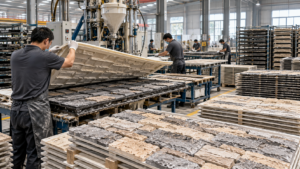
China is one of the major sourcing destinations for decorative wall panels, including PU stone wall panels, PU faux stone panels, and modern 3D PU wall panels.
For international importers, wholesalers, distributors, contractors, and building-material brands, working with the right Chinese PU wall panel manufacturer can offer several advantages, including competitive production costs, a wide range of designs, product customization, and flexible supply solutions.
However, choosing a reliable manufacturer is not always easy.
Many suppliers claim to be professional factories, offer attractive prices, and display impressive product catalogs. But how can you determine whether a supplier has genuine manufacturing capabilities, consistent product quality, and the experience to support your business?
The lowest quotation does not necessarily represent the best purchasing decision.
A reliable PU wall panel manufacturer should offer more than products. It should provide consistent quality, transparent specifications, dependable production, professional communication, and long-term cooperation.
This guide explains how to evaluate Chinese PU wall panel manufacturers and what international buyers should check before placing an order.
1. Understand What You Need Before Contacting Manufacturers
Before searching for a PU wall panel factory in China, define your product requirements and target market.
Different markets have different preferences for design, dimensions, installation methods, packaging, and price levels.
Choose the Right PU Wall Panel Category
PU wall panels cover several decorative product categories.
PU Stone Wall Panels
- PU Culture Stone
- PU Faux Stone
- PU Mushroom Stone
- PU Rock Stone
- PU Stacked Stone
- PU Slate Stone
- PU Brick Stone
- PU Stone Veneer
Modern PU Wall Panels
- PU Geometry Panels
- 3D PU Wall Panels
- PU Wave Panels
- Modern Decorative Panels
- Abstract PU Panels
- Luxury PU Wall Panels
Architectural and Exterior Decorative Panels
- PU Exterior Wall Panels
- Villa Exterior Panels
- Garden Wall Decoration
- Courtyard Wall Panels
- Commercial Decorative Wall Panels
Not every factory specializes in all these categories.
Some manufacturers focus primarily on traditional stone textures, while others invest more in modern geometric designs and architectural decoration.
Choose suppliers whose actual product development capabilities match your target market.
Define Your Purchasing Requirements
Prepare a basic purchasing specification:
| Requirement | What to Confirm |
|---|---|
| Product category | PU stone or modern PU panels |
| Design | Stone, brick, geometric, 3D, etc. |
| Dimensions | Length, width, and thickness |
| Color | Standard or customized |
| Application | Interior or exterior |
| Quantity | Sample, trial order, or container |
| Packaging | Standard or private label |
| Market | Destination country |
| Certifications | Applicable market requirements |
| Cooperation | Wholesale, OEM, or ODM |
Having these details ready makes it easier to compare suppliers accurately.
2. Check Whether the Supplier Is a Real Manufacturer
One of the first things to verify is whether you are dealing directly with a manufacturer, a trading company, or a business combining both functions.
All three may have a role in international trade, but their capabilities can be different.
Manufacturer vs. Trading Company
| Factor | PU Wall Panel Manufacturer | Trading Company |
|---|---|---|
| Production | Operates or manages manufacturing facilities | Usually purchases from factories |
| Product development | May offer direct product development | Depends on manufacturing partners |
| Customization | Can offer direct production customization | Depends on factory cooperation |
| Production scheduling | Greater control when production is in-house | Depends on supplier arrangements |
| Quality control | Can manage production-stage inspection | Depends on inspection arrangements |
| Product range | Often focused on particular categories | May offer more categories |
| Communication | Direct access to production information may be possible | Communication may pass through suppliers |
A trading company is not necessarily unreliable. Some trading companies have strong supplier networks and professional export services.
The important question is whether the supplier can meet your requirements transparently and consistently.
How to Verify a PU Wall Panel Factory
Ask for:
- Company registration information
- Factory address
- Production workshop photos and videos
- Manufacturing equipment information
- Product manufacturing process
- Quality-control procedures
- Production capacity information
- Factory inspection arrangements
For a large order, consider arranging an independent factory audit or an on-site visit.
A genuine manufacturer should be comfortable explaining how its products are made and how quality is controlled.
3. Evaluate the Factory’s Product Range and Specialization
A professional PU wall panel manufacturer should have a clear understanding of its main products.
A large catalog alone does not prove manufacturing expertise.
For example, a supplier may display hundreds of decorative wall materials, but its actual production experience may be concentrated in only a few categories.
Look for Product Specialization
Evaluate whether the factory understands:
- PU material and panel construction
- Mold development
- Surface texture and finishing
- Product dimensions and tolerances
- Color consistency
- Panel weight
- Packaging requirements
- Installation methods
- Interior and exterior applications
Check Whether the Designs Are Original or Repeated
For distributors, product differentiation is commercially important.
Ask whether the factory can provide:
- Existing design collections
- New product development
- Custom textures
- Custom colors
- Private-label products
- Exclusive designs, where commercially agreed
A supplier that can continuously develop new products may help distributors maintain a competitive product range.
Consider Modern PU Products Separately
If your market focuses on contemporary architecture, do not evaluate a factory only by its traditional PU culture stone collection.
Check whether it offers:
- Geometric PU panels
- Minimalist wall designs
- 3D decorative surfaces
- Modern stone textures
- Large-format decorative panels
- Exterior architectural designs
The factory’s design direction should match the direction in which your market is developing.
4. Check PU Wall Panel Quality Before Placing an Order
Product quality is one of the most important factors when selecting a PU wall panel manufacturer.
A panel may look attractive in a product photo but perform differently in actual production.
You should evaluate both the physical sample and the manufacturer’s quality-control process.
Important Quality Factors
1. Material Consistency
Ask about the polyurethane material formulation and how the factory maintains consistency between production batches.
2. Panel Dimensions
Check whether the actual dimensions match the specification.
Significant dimensional variations can create problems during installation and joint alignment.
3. Thickness and Weight
Compare panel thickness and weight with the manufacturer’s declared specifications.
Neither thickness nor weight alone establishes quality, but they are useful parameters for checking consistency.
4. Surface Texture
Inspect the texture carefully.
Good decorative panels should reproduce the intended design with reasonably consistent detail and finish.
5. Color Consistency
Check whether samples and mass-production products have consistent colors.
This is especially important when ordering multiple cartons for the same project.
6. Surface Coating
For painted or coated products, inspect:
- Color uniformity
- Surface adhesion
- Visible coating defects
- Scratches
- Peeling
- Finish consistency
For exterior applications, also ask about the coating’s UV and weathering performance.
7. Panel Edges and Connections
Check whether edges are clean and whether the panel design allows practical installation and joint treatment.
Request Samples Before Ordering
Never rely exclusively on catalog photographs for a large purchase.
A practical evaluation process is:
- Request physical samples.
- Check dimensions and weight.
- Inspect the decorative surface.
- Test the recommended installation method.
- Compare different designs.
- Review available technical information.
- Approve the sample before mass production.
For important projects, retain an approved reference sample for comparison with the production batch.
5. Ask About Manufacturing Equipment and Production Capacity
Production capacity matters when you plan to import PU wall panels regularly or supply large construction and decoration projects.
However, a factory’s stated monthly production capacity should not be accepted without understanding how it is calculated.
Ask about:
- Number of production lines
- Molds and available designs
- Production equipment
- Daily or monthly output
- Current production schedule
- Labor and quality-control arrangements
- Peak-season production planning
- Capacity for customized orders
Why Does Mold Availability Matter?
PU wall panels often depend on molds to create decorative textures and shapes.
The manufacturer’s mold resources can influence:
- Product variety
- New design development
- Production efficiency
- Surface detail
- Customization possibilities
A supplier with relevant mold-development capabilities may be better positioned to support product differentiation.
For distributors planning long-term cooperation, the factory’s ability to introduce new designs can be as important as its current production capacity.
6. Check Whether the Factory Supports OEM and ODM
OEM and ODM services are particularly important for importers, distributors, wholesalers, and private-label brands.
What Is OEM?
OEM generally refers to producing products according to a buyer’s requirements or brand specifications.
Examples include:
- Private-label packaging
- Customized product labels
- Brand logos
- Customized cartons
- Product specifications
- Agreed product designs
What Is ODM?
ODM involves product development or customization based on the buyer’s ideas and requirements.
For PU wall panels, this may include:
- Customized textures
- New mold development
- Customized colors
- Modified panel dimensions
- Exclusive design projects
Questions to Ask
- Can you print our brand logo on cartons?
- Can you customize product colors?
- Can you develop new panel designs?
- Is there an MOQ for customized products?
- Who owns the customized mold?
- What is the mold development cost?
- Can the design be exclusive to our market?
- What is the lead time for customized production?
Make sure customization conditions, design ownership, exclusivity, and mold costs are agreed in writing before production.
7. Evaluate Export Experience and International Trade Services
A factory may produce good products but lack the experience to support international buyers effectively.
Export capability is especially important for buyers purchasing by container.
Important Export Services
A reliable export-oriented supplier should be able to discuss:
- International quotations
- Product specifications
- Pro forma invoices
- Export packaging
- Commercial documentation
- Shipping arrangements
- Container loading
- FOB and other agreed trade terms
- Production updates
- After-sales communication
Understand Packaging Quality
PU wall panels are relatively lightweight, but poor packaging can still lead to product damage during transportation.
Check:
- Carton dimensions
- Packing quantity
- Product protection
- Carton strength
- Pallet requirements
- Shipping marks
- Private-label packaging options
Ask the factory for actual packaging photos and loading pictures.
For large orders, container loading should be planned according to product dimensions, carton sizes, weight restrictions, and destination requirements.
Ask About Export Markets
A manufacturer with experience serving overseas customers may better understand different market requirements.
Ask:
- Which countries do you currently supply?
- Have you supplied distributors or wholesalers?
- Can you provide references or documented project examples?
- Are product documents available for our target market?
- Can you support destination-specific packaging requirements?
Export history is useful evidence, but it should not replace verification of the factory’s current capabilities.
8. Check Certifications and Technical Documentation
Certifications and test reports can be important when importing building and decorative materials.
However, requirements vary by country, product category, and intended application.
Do not assume that a supplier’s general company certificate proves that every PU wall panel complies with your market’s regulations.
Documents Worth Requesting
Depending on the product and destination market, ask about:
- Product technical data sheets
- Safety data sheets, where applicable
- Material information
- Fire-performance test reports
- Relevant environmental test reports
- UV or weathering test reports
- Applicable product certifications
- Installation instructions
- Warranty documentation
Pay Attention to Fire Performance
Fire performance is particularly important for certain public buildings, commercial projects, and regulated applications.
Ask for test reports that identify the exact product, specimen construction, test method, and classification.
Do not accept general statements such as “fireproof” or “fire-resistant” without appropriate supporting documentation.
The applicable requirements should be checked for the destination market and intended building application.
9. Compare Prices Carefully: Do Not Choose Only the Cheapest Factory
Price is important, particularly for importers competing in wholesale markets.
However, comparing quotations only by unit price can produce misleading results.
Two factories may quote different prices because their products differ in:
- Dimensions
- Thickness
- Weight
- Material construction
- Surface coating
- Packaging
- Product design
- Quality-control standards
What Should You Compare?
| Cost Factor | What to Check |
|---|---|
| Unit price | Price per panel or square meter |
| Specifications | Same dimensions and construction? |
| Packaging | Included or charged separately? |
| Customization | Logo, color, or mold costs? |
| Samples | Sample and shipping charges |
| Delivery | Production lead time |
| Shipping | FOB or other agreed trade terms |
| Quality control | Inspection arrangements |
| After-sales | Damage and quality-claim procedures |
Calculate the Total Landed Cost
For importers, the factory quotation is only one component of the final purchasing cost.
Consider:
Total Landed Cost = Product Cost + Packaging + Origin Charges + Freight + Insurance + Customs Duties + Import Taxes + Local Transport
The exact calculation depends on the agreed trade terms and destination country.
A slightly higher factory price may offer better value if the supplier provides more consistent quality, stronger packaging, reliable production, and fewer after-sales problems.
10. Evaluate Communication and After-Sales Service
Communication is often overlooked when buyers compare manufacturers.
However, it becomes extremely important when handling samples, customized orders, production changes, shipping schedules, and quality problems.
A Professional Supplier Should Be Able to:
- Respond to product inquiries clearly
- Provide accurate specifications
- Explain technical differences
- Offer suitable product recommendations
- Confirm quotations in writing
- Communicate production progress
- Provide packing and loading information
- Handle quality feedback professionally
Watch Out for Warning Signs
Be cautious when a supplier:
- Avoids providing a verifiable factory address
- Cannot explain basic product specifications
- Uses inconsistent product information
- Refuses reasonable sample requests
- Makes unsupported performance claims
- Frequently changes quoted prices
- Cannot provide clear production timelines
- Pressures buyers into large advance payments
- Refuses agreed inspection arrangements
- Offers unusually low prices without explaining the specifications
One warning sign does not automatically prove that a supplier is unreliable. Look at the overall picture and verify important information independently.
11. Visit the Factory or Arrange an Independent Inspection
For a first-time supplier relationship, especially when the order value is significant, factory verification is a sensible step.
What to Inspect During a Factory Visit
Production Area
- Actual manufacturing activities
- Production equipment
- Molds and tooling
- Raw material storage
Quality-Control Area
- Inspection procedures
- Finished-product samples
- Defect handling
- Packaging inspection
Warehouse
- Finished-product inventory
- Carton quality
- Product labeling
- Storage conditions
Management and Export Team
- Order management
- Production planning
- Communication process
- Export documentation
What If You Cannot Visit China?
You can still reduce risk by arranging:
- A live video factory tour
- Independent factory verification
- Pre-production sample approval
- Pre-shipment inspection
- Third-party quality inspection
- Written product specifications
For container orders, an independent pre-shipment inspection can help verify quantity, appearance, packing, and other agreed requirements.
12. How Many PU Wall Panel Manufacturers Should You Compare?
For a new sourcing project, comparing approximately three to five qualified suppliers is a practical starting point.
Too few suppliers may limit your understanding of the market. Too many can make the evaluation process unnecessarily complicated.
Use the same specifications when requesting quotations.
For example, ask each supplier to quote the same:
- Product model
- Dimensions
- Color
- Quantity
- Packaging requirements
- Delivery terms
- Customization options
Then compare the samples and commercial conditions side by side.
A Practical Supplier Evaluation Scorecard
Use this scorecard to organize your supplier research.
| Evaluation Item | Suggested Weight |
|---|---|
| Product quality and consistency | 25% |
| Manufacturing capability | 20% |
| Product range and development | 15% |
| Export and packaging experience | 15% |
| Price and commercial terms | 10% |
| OEM/ODM support | 10% |
| Communication and service | 5% |
| Total | 100% |
These weights are a suggested purchasing framework, not an industry standard.
You can adjust them according to your business model. For example, a private-label brand may assign more importance to OEM/ODM, while a project contractor may prioritize technical documentation and installation support.
13. Questions to Ask a PU Wall Panel Manufacturer Before Ordering
Before making a purchasing decision, prepare a supplier questionnaire.
About the Factory
- Are you a manufacturer or trading company?
- Where is your production facility located?
- Which PU wall panel products do you manufacture?
- Can you provide production videos?
- What is your production capacity?
About Product Quality
- What are the panel dimensions and thickness?
- What is the average panel weight?
- What material and surface coating are used?
- Which models are suitable for exterior applications?
- Can you provide relevant technical documents and test reports?
About Customization
- Do you support OEM and ODM?
- Can you customize colors and packaging?
- Can you develop new molds?
- What is the MOQ for customized orders?
About Orders and Shipping
- What is your standard MOQ?
- What is your production lead time?
- What are your payment terms?
- How are the products packed?
- Can you provide container loading information?
About After-Sales Service
- What happens if products are damaged during transportation?
- What is covered by the product warranty?
- Can you provide installation guidance?
- How do you handle quality claims?
A supplier that can answer these questions clearly makes the purchasing process easier to manage.
14. Why Choose a Specialized PU Wall Panel Supplier?
When searching for a PU wall panel manufacturer in China, you may find suppliers offering many unrelated decorative building materials.
A broad product portfolio can be useful, but there are advantages to working with a supplier that has strong expertise in your target category.
A specialized PU wall panel supplier may offer:
Better Product Knowledge
A clearer understanding of PU panel construction, designs, specifications, and installation requirements.
More Focused Product Development
Greater attention to new stone textures, geometric designs, modern finishes, and market trends.
More Relevant Technical Support
Product-specific guidance about cutting, installation, adhesive compatibility, and application limitations.
A More Consistent Product Collection
A structured range that can help distributors build a recognizable brand and product portfolio.
For buyers planning to develop a long-term PU wall panel business, specialization can be a valuable advantage.
15. FOROREE: A PU Wall Panel Supplier for Global Decoration Markets
FOROREE focuses on PU wall panels and PU stone wall panels for residential, commercial, and architectural decoration markets.
Our product direction combines two important design categories:
PU Stone Collection
Traditional stone-inspired decorative panels, including:
- PU Culture Stone
- PU Faux Stone
- PU Rock Stone
- PU Mushroom Stone
- PU Brick Stone
- PU Slate Stone
- PU Stacked Stone
Modern PU Collection
Contemporary decorative designs for modern architectural spaces:
- PU Geometry Panels
- 3D PU Wall Panels
- Modern Decorative PU Panels
- Abstract and Contemporary Designs
- Modern Stone-Inspired Panels
Supporting International Buyers
For importers, distributors, wholesalers, contractors, and project buyers, FOROREE aims to support more than the product purchase itself.
Our cooperation direction includes:
Product Selection
A range of PU stone and modern PU wall panel designs for different decoration markets.
Samples and Product Information
Samples, product specifications, and information to help buyers evaluate products before ordering.
OEM and Private Label
Brand packaging, product customization, and cooperation based on agreed requirements.
Installation Guidance
Product-specific installation recommendations and technical information.
Wholesale and Project Support
Quotation assistance, packaging planning, order coordination, and container loading arrangements.
Our goal is to build long-term cooperation with overseas partners through product quality, communication, and dependable service.
Looking for a PU Wall Panel Manufacturer in China?
Choosing the right supplier is the first step toward building a successful wall panel business.
Contact FOROREE to discuss your product requirements, request samples, and explore wholesale or OEM cooperation.
FOROREE — The PU Wall Panel Specialist
Realistic Stone. Modern Design. Lightweight Installation.
Conclusion
Choosing a reliable PU wall panel manufacturer in China requires more than comparing product photos and quotations.
International buyers should evaluate the supplier’s actual manufacturing capabilities, product consistency, technical documentation, production management, customization options, export experience, and communication.
Before placing a large order:
- Define your product requirements.
- Verify the supplier’s business and factory information.
- Request physical samples.
- Compare technical specifications.
- Check applicable certifications and test reports.
- Confirm production, packaging, and payment terms.
- Arrange inspections where appropriate.
- Establish clear after-sales procedures.
The right PU wall panel manufacturer is not necessarily the cheapest supplier. It is the supplier that can consistently meet your product, quality, delivery, and business requirements.