
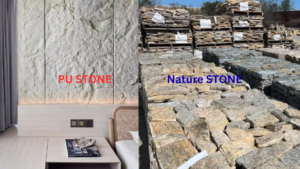
When choosing a wall finish for a residential, commercial, or exterior project, PU stone and natural stone are two options worth considering.
Natural stone offers authentic geological texture, unique variation, and a long history in architecture. PU stone wall panels, on the other hand, are manufactured decorative panels designed to reproduce the appearance of stone while reducing weight and simplifying handling and installation.
So, what is the difference between PU stone and natural stone?
The answer depends on what matters most for your project: authenticity, weight, installation, transportation, design flexibility, cost, durability, or project requirements.
In this guide, we compare PU stone and natural stone across the factors that matter most to homeowners, designers, contractors, importers, and distributors.
Quick Comparison: PU Stone vs Natural Stone
| Feature | PU Stone | Natural Stone |
|---|---|---|
| Material | Polyurethane-based manufactured panel | Naturally occurring stone |
| Appearance | Designed to reproduce stone | Genuine natural stone |
| Weight | Generally lightweight | Generally heavy |
| Handling | Easier | More difficult |
| Transportation | Lower weight can simplify logistics | Heavy and costly to transport |
| Installation | Generally faster and simpler | Usually more labor-intensive |
| Cutting | Relatively easy with suitable tools | Requires appropriate stone-cutting equipment |
| Design consistency | More consistent between panels | Natural variation between pieces |
| Design variety | Many manufactured textures and colors | Depends on available stone types |
| Customization | Manufacturer-dependent | Limited |
| Structural load | Lower | Higher |
| Maintenance | Depends on product and installation | Depends on stone type and finish |
| Outdoor use | Product-dependent | Commonly used outdoors |
| Authenticity | Stone appearance | Genuine stone |
| Best suited to | Decorative wall applications where lightweight installation is useful | Projects requiring authentic natural stone |
Important: Actual performance varies between products. PU panels from different manufacturers can have significantly different formulations, densities, coatings, and test results.
1. What Is PU Stone?
PU stone is a decorative wall panel made primarily from polyurethane (PU) and manufactured to reproduce the appearance of natural stone.
Manufacturers use molds to create three-dimensional surfaces that can imitate:
- Stacked stone
- Slate
- Rock
- Mountain stone
- Sandstone
- Brick
- Modern architectural stone
The finished panels can then be colored, coated, and detailed to create a realistic stone appearance.
PU stone is therefore not real stone. It is a manufactured decorative material inspired by natural stone.
Its main attraction is the combination of:
Stone appearance + lightweight construction + easier handling.
2. What Is Natural Stone?
Natural stone is quarried directly from geological formations and processed into products suitable for construction and decoration.
Common natural stones include:
- Granite
- Marble
- Limestone
- Sandstone
- Slate
- Travertine
- Quartzite
Because natural stone forms naturally over geological time, each piece can have its own:
- Color
- Veining
- Grain
- Texture
- Mineral composition
- Surface variation
This natural variation is one of the main reasons architects and designers choose genuine stone.
3. PU Stone vs Natural Stone: Appearance
Natural Stone
Natural stone provides something manufactured materials cannot completely reproduce:
natural geological variation.
Two pieces of natural stone may differ in color, grain, texture, and pattern.
For luxury projects where authentic natural material is an important design requirement, this can be a major advantage.
PU Stone
Modern PU stone panels can reproduce highly detailed stone textures through molds and surface finishing.
The advantage is design consistency.
A manufacturer can produce large quantities of panels with a similar appearance, which can be useful for commercial projects and distribution.
Which should you choose?
If your priority is:
Authentic natural material → Natural stone
If your priority is:
Consistent decorative appearance + lightweight installation → PU stone
4. Weight: PU Stone vs Natural Stone
This is one of the biggest differences.
Natural stone is dense and therefore relatively heavy.
A large amount of natural stone may require:
- More transportation capacity
- More labor for handling
- Stronger structural support
- More effort during installation
PU stone panels are manufactured from polyurethane and are generally much lighter than traditional stone products.
This can make them easier to:
- Carry
- Store
- Transport
- Cut
- Position
- Install
For renovation projects, lightweight materials can be particularly useful when minimizing additional structural load is important.
However, don’t compare products based only on the word “lightweight.” Always check the actual weight per panel or square meter.
5. Installation: Which Is Easier?
Natural Stone
Installing natural stone may involve:
- Surface preparation
- Material transportation
- Cutting
- Mortar or adhesive
- Positioning
- Grouting or joint finishing
- Sealing, depending on the stone
- Cleaning
Large or heavy stone pieces can require experienced installers and specialized equipment.
PU Stone
PU stone panels are designed as decorative wall panels.
A typical installation may involve:
- Measuring
- Cutting
- Applying the recommended adhesive
- Positioning panels
- Additional fixing where required
- Finishing joints
- Touch-up
The exact method depends on the panel and substrate.
For this reason, PU stone can be attractive for projects where installation speed and handling efficiency are important.
6. Transportation and Logistics
Transportation is another major consideration for B2B buyers.
Natural stone is heavy.
For importers and distributors, this means freight costs can represent a significant part of the landed cost, particularly when shipping large quantities over long distances.
PU stone panels are much lighter.
This can provide advantages in:
- Container loading
- Manual handling
- Warehouse movement
- Delivery to construction sites
- International transportation
For an importer, therefore, the question isn’t only:
“How much does one square meter cost?”
A better calculation is:
Product cost + packaging + freight + handling + installation cost = total project cost
This is particularly important when comparing materials sourced internationally.
7. Installation Labor
Natural stone installation can require more specialized labor because installers may need to handle heavy materials, perform stone cutting, prepare substrates, and finish joints.
PU panels are generally designed to simplify handling and installation.
That doesn’t mean every PU installation is automatically inexpensive or fast.
Actual labor savings depend on:
- Wall condition
- Panel design
- Panel size
- Installation method
- Installer experience
- Adhesive system
- Project complexity
For large commercial projects, however, installation efficiency can become an important factor when comparing materials.
8. Design Variety
Natural stone offers a huge variety of genuine geological materials.
However, each stone type is naturally limited by what can be quarried and processed.
PU manufacturers can create different designs through mold development and surface finishing.
This allows product collections such as:
Natural Stone Styles
- Stacked Stone
- Rock Stone
- Slate
- Mountain Stone
- Sandstone
- Mushroom Stone
Modern Architectural Styles
- Geometric
- Linear
- 3D
- Contemporary
- Minimalist
- Industrial
For distributors, this means PU stone can provide a broad product catalog without requiring access to many different quarries.
9. Color Consistency
Natural stone naturally varies.
This is part of its character, but it can also make large projects more difficult to match perfectly.
PU panels are manufactured products, so manufacturers can aim for a more consistent appearance between panels and production batches.
However, color consistency still depends on:
- Raw materials
- Pigments
- Surface finishing
- Production conditions
- Quality control
For a large project, buyers should always request samples and confirm the manufacturer’s batch-control procedures.
10. Durability
Natural stone is well known for its durability, and many types of natural stone have been used in architecture for centuries.
However, durability varies considerably between different stones.
For example, granite, limestone, sandstone, marble, and slate have different physical properties and maintenance requirements.
PU stone durability also varies by product.
Important factors include:
- PU formulation
- Density
- Surface coating
- UV exposure
- Temperature
- Moisture
- Installation quality
- Maintenance
Therefore, it is better to ask a PU manufacturer for specific technical data and test reports rather than relying on a generic claim such as “20-year lifespan.”
11. Outdoor Applications
Both materials can be used in exterior architecture, but their requirements are different.
Natural stone is widely used for:
- Building façades
- Garden walls
- Retaining walls
- Outdoor landscaping
- Architectural features
Some PU stone products are also designed for exterior decorative applications, including:
- Villa façades
- Entrance walls
- Garden walls
- Outdoor feature walls
- Commercial buildings
For exterior PU applications, check the manufacturer’s information regarding:
- UV resistance
- Weather resistance
- Temperature range
- Moisture exposure
- Surface coating
- Installation requirements
Local building codes should also be considered.
12. Maintenance
Natural stone maintenance depends heavily on the type of stone and the finish.
Some natural stones may require:
- Sealing
- Periodic cleaning
- Stain protection
- Special cleaning products
PU stone can have different maintenance requirements depending on the manufacturer’s surface treatment and installation system.
For either material, proper installation and appropriate cleaning are important for maintaining appearance.
13. Cost: Is PU Stone Cheaper Than Natural Stone?
This is one of the most common questions, but there is no universal answer.
The material price of natural stone varies enormously depending on:
- Stone type
- Quarry
- Grade
- Finish
- Thickness
- Country of origin
- Transportation
The cost of PU stone varies depending on:
- Design
- Dimensions
- Density
- Surface finish
- Order quantity
- Manufacturer
- Packaging
- Destination
More importantly, the total installed cost includes much more than the panel itself.
Consider:
Natural Stone
Stone + transportation + handling + cutting + labor + installation + possible structural preparation + maintenance
PU Stone
Panel + transportation + adhesive/fixings + labor + installation + finishing
In some projects, the lighter weight and simpler installation of PU stone can reduce total project costs.
The only reliable way to compare is to calculate the complete installed cost for the specific project.
14. PU Stone vs Natural Stone for Importers
For importers and distributors, the comparison becomes even more interesting.
Natural stone requires managing a relatively heavy product with significant logistics considerations.
PU stone can offer:
- Lower product weight
- Easier handling
- More consistent designs
- Large design collections
- OEM opportunities
- Private-label packaging
- Easier sample distribution
For an importer building a wall-decoration product line, PU stone can therefore be a flexible category to develop.
But buyers should carefully evaluate the manufacturer’s:
- Factory capability
- Product quality
- Packaging
- MOQ
- Lead time
- Production capacity
- Export experience
- Technical documentation
- OEM capability
15. PU Stone vs Natural Stone: Which One Should You Choose?
There isn’t one material that is right for every project.
Choose Natural Stone when:
- Genuine natural material is essential
- Natural variation is part of the design
- Long-term stone construction is required
- The project specifically specifies natural stone
- The weight and installation requirements are acceptable
Consider PU Stone when:
- Lightweight materials are important
- Faster installation is desired
- Transportation weight matters
- A consistent decorative appearance is preferred
- Many design options are needed
- The project requires decorative stone appearance rather than structural stone
- OEM or customized products are valuable
- The project involves renovation or interior feature walls
The final decision should always be based on the project’s specific technical and design requirements.
16. What Should You Ask a PU Stone Manufacturer?
If you’re purchasing PU stone for a commercial project or importing it for distribution, ask the manufacturer:
Product Information
- What is the panel size?
- What is the panel thickness?
- What is the weight per panel?
- What is the weight per square meter?
- What is the PU density?
- What surface coating is used?
Performance
- Is the product suitable for outdoor use?
- What UV/weathering tests are available?
- What fire-test documentation is available?
- What temperature range is recommended?
- What installation system is recommended?
Commercial
- What is the MOQ?
- What is the lead time?
- Can you provide samples?
- Can you provide OEM packaging?
- Can you provide private labeling?
- How many designs are available?
Factory
- Where is the factory located?
- What is the production capacity?
- What quality-control procedures are used?
- Can you provide production photos or videos?
- Do you have experience exporting internationally?
A professional manufacturer should be able to answer these questions clearly.
17. Why FOROREE PU Stone?
FOROREE focuses on PU stone and decorative PU wall panels for international residential and commercial markets.
Rather than treating PU stone as simply another wall-decoration product, FOROREE focuses on developing a dedicated PU product collection for distributors, contractors, designers, and project buyers.
Our focus includes:
Realistic Stone Designs
PU panels developed to reproduce the texture and appearance of different architectural stone styles.
Lightweight Installation
A practical alternative for projects where handling and installation efficiency are important.
Multiple Design Collections
From natural rock and stacked stone to modern architectural textures.
OEM & Private Label
Support for selected customization, packaging, and private-label requirements.
B2B Supply
Samples, quotations, production coordination, export packaging, and container shipment support.
Frequently Asked Questions
Is PU stone real stone?
No. PU stone is a manufactured polyurethane-based decorative wall panel designed to reproduce the appearance of natural stone.
Is PU stone lighter than natural stone?
Generally, yes. PU panels are designed as lightweight decorative products, while natural stone is relatively dense. Always compare the actual weight per square meter.
Does PU stone look like real stone?
High-quality PU panels can reproduce detailed stone textures and colors. However, natural stone has genuine geological variation that manufactured panels cannot completely reproduce.
Is PU stone suitable for exterior walls?
Some products are specifically designed for exterior applications. Check the manufacturer’s UV, weather, moisture, temperature, and installation specifications before using a product outdoors.
Which is cheaper, PU stone or natural stone?
There is no universal answer. Compare the complete installed cost, including material, transportation, labor, installation, and other project costs.
Is PU stone easier to install?
PU panels are generally designed to be easier to handle and install than heavy stone products, but the actual installation time depends on the product, substrate, installer, and project.
Is PU stone environmentally friendly?
Environmental performance depends on the specific material formulation, manufacturing process, product lifespan, and disposal or recycling options. Buyers should request relevant environmental documentation rather than relying on generic claims.
Can PU stone replace natural stone?
PU stone can replace the decorative appearance of natural stone in many applications, but it is not a structural replacement for natural stone or masonry. Projects with specific material, structural, fire, or code requirements should use the material specified for that application.
Final Verdict: PU Stone or Natural Stone?
The choice between PU stone and natural stone isn’t simply about which material is “better.”
It is about which material fits the project.
Natural stone offers authentic material, unique natural variation, and established long-term use in architecture.
PU stone offers a manufactured stone appearance with advantages in areas such as weight, handling, design consistency, installation efficiency, and product customization.
For residential renovations, feature walls, hospitality projects, commercial interiors, selected exterior applications, and international wall-decoration distribution, PU stone can be a practical alternative to traditional stone.
For projects where genuine stone is essential, natural stone remains the appropriate choice.
Before making a decision, compare the appearance, weight, installation, transportation, technical performance, maintenance, and total installed cost of the specific products—not just the material names.
Looking for a PU stone wall panel manufacturer? Explore FOROREE’s PU Stone Collection or contact our team for product samples and wholesale information.